 Add to Chrome
 Add to Firefox
 Add to Edge
Visual Latents Know More Than They Say: Unsilencing Latent Reasoning in MLLMs
May 04, 2026
Continuous latent-space reasoning offers a compact alternative to textual chain-of-thought for multimodal models, enabling high-dimensional visual evidence to be integrated without explicit reasoning tokens. However, we identify a previously overlooked optimization pathology in existing latent visual reasoning methods: although visual latents become semantically enriched during training, their contribution to final answer prediction is systematically suppressed. Within the shared parameter space, the autoregressive objective favors shortcut reliance on direct visual input, driving latent tokens toward transition-like states rather than informative reasoning content. We term this phenomenon Silenced Visual Latents. To address it, we disentangle the two conflicting objectives by directly optimizing the latent reasoning at inference time, keeping backbone parameters frozen. In Stage I, visual latents are warmed up via query-guided contrastive latent--visual alignment, improving semantic quality while preventing latent collapse. In Stage II, the latent reasoning is further optimized via a confidence-progression reward, which incentivizes predicted token distributions along the latent span to become progressively more concentrated, routing predictions through the latent reasoning rather than bypassing it. Experiments across eight benchmarks and four model backbones show that inference-time latent optimization, without any parameter updates, effectively unleashes the suppressed reasoning capacity of visual latents.

Evolving from Single-modal to Multi-modal Facial Deepfake Detection: A Survey
Jun 11, 2024

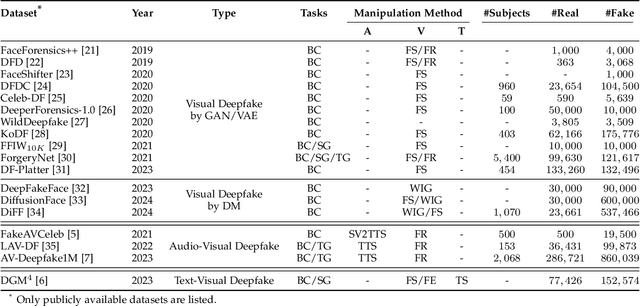
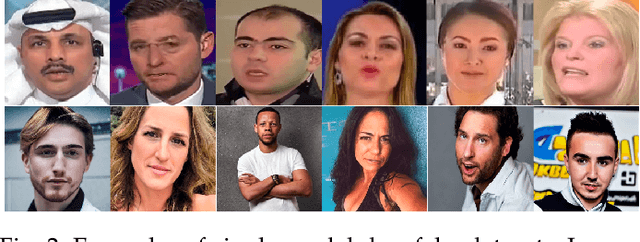
This survey addresses the critical challenge of deepfake detection amidst the rapid advancements in artificial intelligence. As AI-generated media, including video, audio and text, become more realistic, the risk of misuse to spread misinformation and commit identity fraud increases. Focused on face-centric deepfakes, this work traces the evolution from traditional single-modality methods to sophisticated multi-modal approaches that handle audio-visual and text-visual scenarios. We provide comprehensive taxonomies of detection techniques, discuss the evolution of generative methods from auto-encoders and GANs to diffusion models, and categorize these technologies by their unique attributes. To our knowledge, this is the first survey of its kind. We also explore the challenges of adapting detection methods to new generative models and enhancing the reliability and robustness of deepfake detectors, proposing directions for future research. This survey offers a detailed roadmap for researchers, supporting the development of technologies to counter the deceptive use of AI in media creation, particularly facial forgery. A curated list of all related papers can be found at \href{https://github.com/qiqitao77/Comprehensive-Advances-in-Deepfake-Detection-Spanning-Diverse-Modalities}{https://github.com/qiqitao77/Awesome-Comprehensive-Deepfake-Detection}.